Research Page
Development and Effectiveness Analysis of a Lightweight Serverless AI Agent for Optimizing Learning Workflows
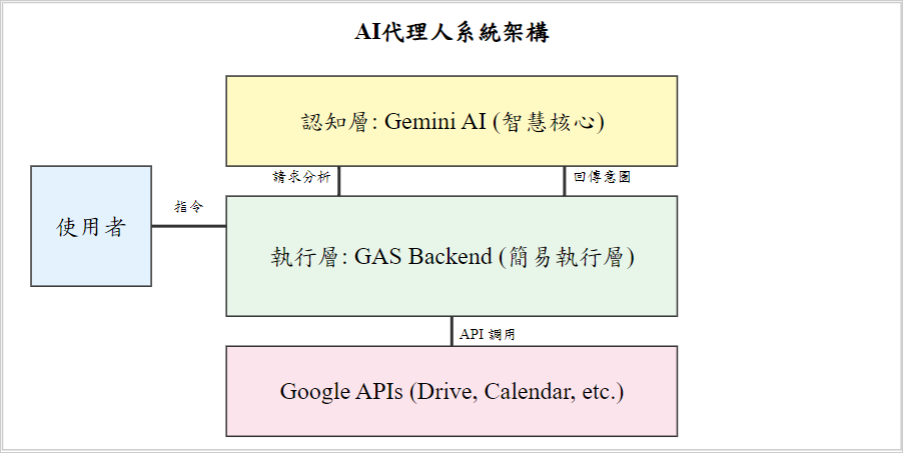
This study proposes and empirically validates a lightweight, serverless Artificial Intelligence (AI) agent framework.
Research Page
This study proposes and empirically validates a lightweight, serverless Artificial Intelligence (AI) agent framework.
Source file: 優化學習工作流輕量級無伺服器 AI 代理人之開發與成效分析.docx.pdf
Lightweight Architecture, Artificial Intelligence Agent, Technology Acceptance Model
This page is generated from the shared research-page structure and uses the site-wide template.
This study proposes and empirically validates a lightweight, serverless Artificial Intelligence (AI) agent framework.
This study proposes and empirically validates a lightweight, serverless Artificial Intelligence (AI) agent framework. The system utilizes Google Apps Script as a streamlined execution layer seamlessly integrated into the existing Google Workspace environments of most campuses. By coupling with a cloud-based large language model (Gemini) for natural language understanding and task planning, the framework delivers a low-barrier AI collaboration experience without requiring additional installations. A structured survey was conducted with 103 participants involved in learning activities, evaluating their perceived usefulness, perceived ease of use, and overall system satisfaction based on the Technology Acceptance Model (TAM). Quantitative analysis revealed three main findings. First, the lightweight architecture effectively lowers operational barriers, leading to highly positive evaluations for system ease of use and overall satisfaction. Second, a significant "AI experience gap" exists…
Figures
Original extracted figures are retained for visual reference and contextual reading.